R100GS after ten years in storage: @workshoprebuild finds metal in the oil, pitted cam followers and a loose valve guide
A few years back I bought an R80 that had sat in a barn near Lindsay for most of a decade. I changed the oil, put in a new battery and had it running the same weekend. It made it a couple of hundred kilometres before the top end started ticking, and when I finally opened it up, the filter was full of glitter and two cam followers were pitted like the moon. That bike is long gone, but since then I look inside every engine before I turn the key, and that is why this series from @workshoprebuild caught my eye.
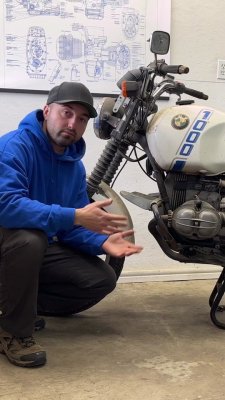
He picked up an R100GS with no known history that had not run in more than ten years, and instead of pouring in fresh oil and hitting the starter, he looked inside the engine first. Both videos are below, in order.
It starts with the oil filter, which lives in a canister on the right side of the block; on this bike the external oil cooler is plumbed into its cover. To reach it he takes off the highway pegs (fun detail: they started life as foot controls from a Lockheed F-104 Starfighter) and the crash bars, undoes three M6 bolts and pries the cover free. Out come the big O-ring, the metal shim in the canister and the inner seal of the oil cooler, and he explains why they matter: get the sealing wrong on an airhead and you lose oil pressure, which can finish the engine.
Instead of binning the two-piece filter, he cuts it open and spreads the pleats. There is metal trapped in there, and much more of it sticks to a magnet than anyone would like. A borescope into the crankcase shows the cam lobes, his first suspect, in good shape, but the cam followers are pitted.
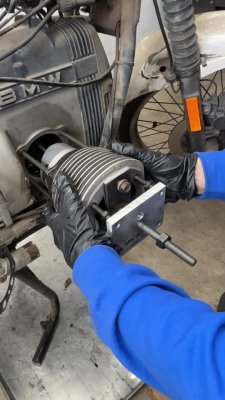
So the top end comes apart. With the valve cover off, the two rockers already disagree: one has a lot of clearance, the other is tight. Both turn out worn and pitted on their contact faces. The pushrods are the one nice surprise, though he still wants to check that they are straight. He cleans around the base of the cylinder so nothing drops into the case, draws it off with a puller and rests the piston on a 3D printed tray. The bore looks decent for its age, with measurements to come after cleaning.
Pulled out with a magnet, the first cam follower has light pitting and the second is badly eaten away. His list of possible causes: not enough oil getting there, poor surface hardness, or a valve train that was set up wrong.
The worst find is on the right head. With the spring compressed and the keepers out, the valve wobbles, and it turns out the whole valve guide is loose in the head. He knocks out the valve, whose keeper grooves are damaged too, and the guide simply drops out as if it had never been pressed in.
He ends by asking whether to save these heads or find another set. After seeing a guide fall out like that, I would be hunting for another set. And learn from my R80: if you buy an airhead that has been sitting, open the filter before the first start. It costs an evening and tells you what the oil has been carrying around.
9 t sitten // 2 kohdetta
📅 29 Nov 2026
👁 1 katselua
💬 0 kommenttia
👍 0